
A Literary Paris
An ode to the flâneur and a Parisian reading list.
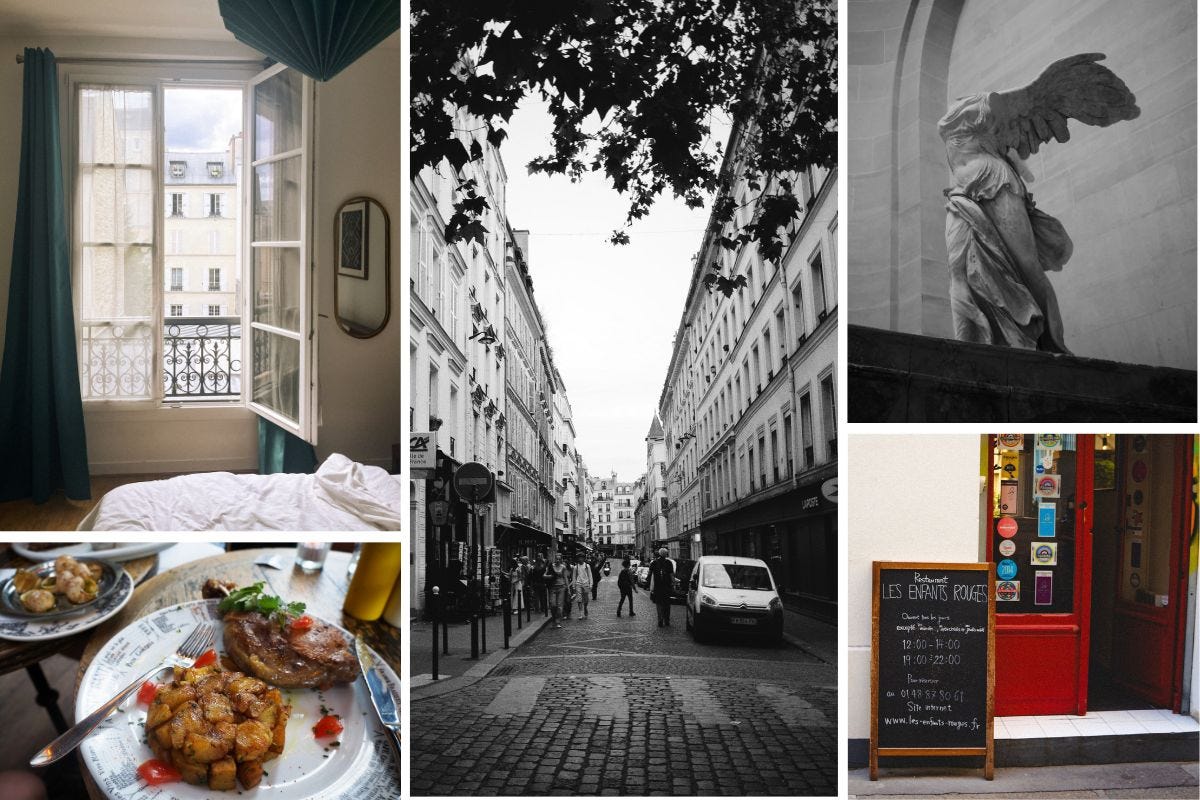
Like many, I first traveled to Paris through books. Madeline as child; then later, the novels of Victor Hugo and Alexandre Dumas. When I was twenty, I worked as a restaurant hostess at a posh and sleepy resort on Anna Maria Island, a job that required very little of me, aside from ushering our one regular—a bejewelled older lady who lived full-time at the resort and spent her evenings regaling the servers with scandals of her yesteryear—to her seat. This left me ample time for reading, specifically a beaten paperback copy of A Moveable Feast that I stashed under the hostess stand when a rare diner walked in. I’ll always think of that summer as the summer of Hemingway’s Paris. An epoch where the crash of the Gulf mingled with artists’ laughter in Les Deux Magots; where umbrella-festooned margaritas were passed alongside crisp Sancerres in seaux à glace. Each time I finished the memoir, slim as it was, I’d read it again from the beginning, telling myself that I’d make it to Paris someday.
It only took twenty years, but earlier this month, my family and I went to Paris for a whirlwind week. My experience couldn’t have been more different from Hemingway’s. While we scoped out the bistros, walked the bohemian sidewalks of Montmarte, and had espressos outside Shakespeare and Co., we largely took a more touristy approach (like the entirety of the world, which seemed to have amassed in one room at the Louvre). But I constantly saw evidence of that popular adage: Paris is a city for writers. Home to Proust and de Beauvoir, Baldwin and the messy scions of La Génération Perdue. I think this is because Paris is a city of the flâneur, Baudelaire’s aimless urban traveler, the tireless observer of human behavior. In Paris, you are encouraged to look, to experience. The bistro tables are set outward, toward the street, rather than toward your companion. The city becomes an offering, a cinematic experience.
In every arrondissement, my senses were constantly stimulated: sugar and yeast from patisseries, urine in alleyways, bikers zipping through muddy puddles, mist on centuries-old gueule de loup (literally: wolf’s mouth) windows, the burden of my own body, swimming among so many others. Romance, grit, a cadence that felt entirely specific, if often challenging. As a visitor to Paris, you can’t help but remain awake.
I once read that travel is so revitalizing because it circumvents our brain’s routine selective filtering mechanism. Typically, we’re accustomed to discarding thousands of points of common input in a given day, but when we travel, we are forced to pay attention to all the details. To wrest with our own discomfort. In this process, the brain rewires. Stretches, expands. Awe allows for neuroplasticity, an asset essential to creatives. I can safely say that I felt in awe every single day, in large moments and small.
Now back in my midwest routine, longing for boulangeries and metros, I’m not sure if I’ll ever experience Hemingway’s Paris. Maybe I can’t. Maybe I shouldn’t. His is, after all, a complicated gaze. But even if my feet won’t find Le Marais again, even if the breeze off the Seine is but a bygone sensation, I can travel back through the pages of authors who, too, have been moved by this incandescent hub of the world.
Books Set in Paris
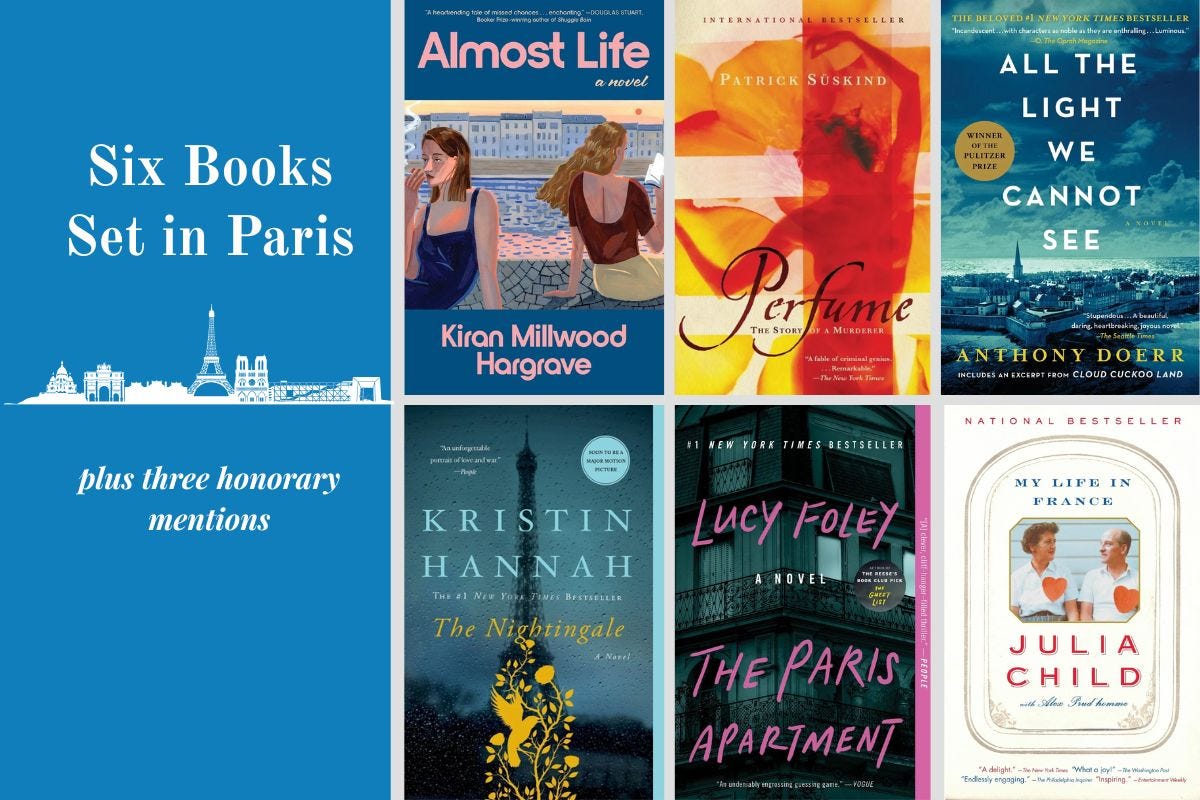
Almost Life by Kiran Millwood Hargrave: Equal parts grit and romance can be found in this novel, which tells a decades-long story of two brilliant women who fall in love in Paris, then separate to rebuild their lives apart. I love this book because, aside from its psychological astuteness and heart-tugging arc, it presents a look at what the Paris of today looks like, in its heady and sometimes dispiriting glory.
Perfume: The Story of a Murder by Patrick Süskind: A dark exploration of love and obsession, centering one man’s terrible quest to distill human essence into a perfume. It’s a murder mystery, a fantasy, and a transportive dive into 18th-century Paris through the eyes of a tortured young man. (The movie is also a visual treat.)
All the Light We Cannot See by Anthony Doerr: This enormously popular novel follows a blind young girl and a German radio prodigy whose lives converge in Nazi-occupied Paris. Rich in sensory details and told in a lyrical, nonlinear style, All the Light We Cannot See gives us a look at a tumultuous period in France that is both epic in scope and intimate in emotional precision.
The Nightingale by Kristin Hannah: Similarly, Hannah’s lengthy novel is an ambitious feat of historical fiction, telling the story of two sisters whose lives diverge greatly. One remains with her young daughter in the countryside, forced to house German soldiers, while the other participates in the Resistance in Paris. Both risk their lives, daring to dream about a future in which their beloved country is reclaimed. (The audiobook is exceptional, narrated by the one and only Julia Whelan.)
The Paris Apartment by Lucy Foley: For a change in tempo, a thriller by the author of The Guest List, in which a woman arrives in Paris with a plan to move into her brother’s upscale apartment, only to discover that he’s completely disappeared. In addition to the eerie mystery she must solve to find him, she discovers the apartment building full of strange residents reluctant to share information with her.
My Life in France by Julia Child: Cowritten by Child and her great-nephew, Alex Prud’homme, our granddame of bœuf bourguignon delivers a spirited culinary memoir of her extraordinary time in Paris. From hapless newcomer to a rising star at Le Cordon Bleu, Child tackles cooking with her signature determination, instantly endearing herself to readers (if not her exacting instructor at the culinary institute!). Charming, funny, and easily consumed with a plate of cheese and a light red, this book remains one of my favorite comfort readers.
Honorable Mentions: A Moveable Feast by Ernest Hemingway, Les Misérables by Victor Hugo, and A Tale of Two Cities by Charles Dickens
What Parisian novels do you recommend for me? Sending you off with baguettes and bisous—

Like reading Wallflower Chats?
(Absolutely no pressure. I appreciate you being here!)